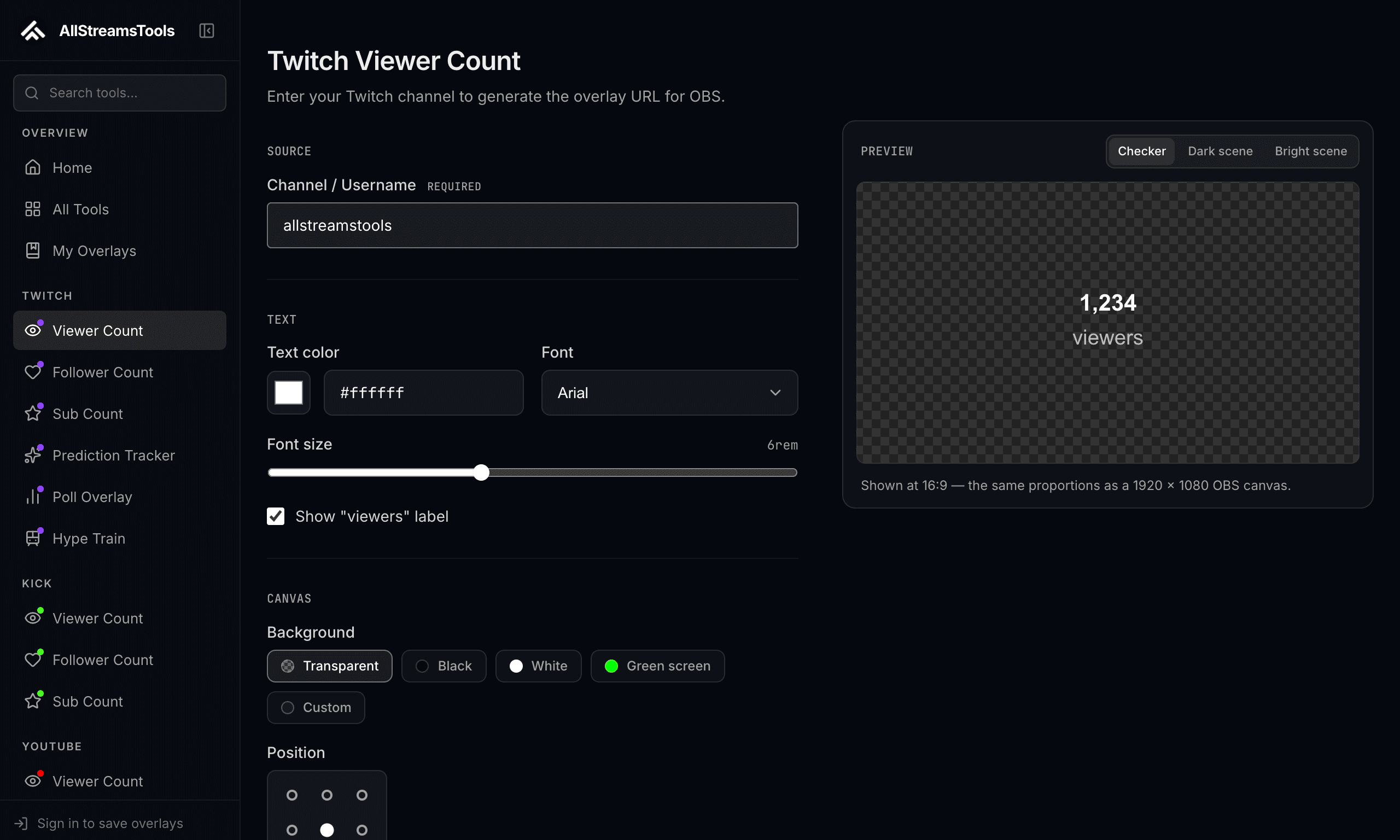
How it works

Configure in the browser. Paste the link into OBS.

No installer, no account for public counts, nothing to keep open beside OBS. Every overlay is a URL.

The viewer count configuration screen: sidebar catalog, controls, and a live transparent preview
  1. 01

    Pick a tool

    Viewer count, chat, now playing, timer, and eighteen more. Each one is a single page doing one job.

  2. 02

    Set it in the URL

    Channel, colour, font and size are query parameters. The link is the configuration.

  3. 03

    Paste into OBS

    Add a Browser Source, paste the link. It renders with a real alpha channel over your scene.

Anatomy of a link

Every setting is a parameter.

Browser Source
allstreamstools.com/chat?channel=yourname&platform=twitch&color=ffffff&font=Inter&size=18
  • channelWhich channel the overlay reads. The only required part.
  • platformWhere the data comes from: twitch, kick or youtube.
  • colorText colour as hex. Change it here, the graphic changes.
  • fontAny font OBS can render.
  • sizeBase font size in pixels.
  • Custom fonts & colours

  • Sizes & positions

  • Fade timers for chat

  • Bot & command filtering

  • Transparent backgrounds

  • No account for public counts

Inside OBS

What the browser source actually does.

What the URL contains

Visual settings live in the URL so OBS renders the same configuration without an editor window. Authenticated tools add a private session reference: treat those links like credentials and keep them out of screenshots and shared scene collections.

What happens when a scene opens

OBS loads the overlay in its built-in browser. Static tools render at once; live counters poll their platform; event tools connect and wait for a poll, prediction, hype train or donation. A transparent event overlay can be working correctly while showing nothing.

Source lifecycle choices

OBS can shut a browser source down when hidden or refresh it when a scene becomes active. That saves resources for static pages but restarts timers, reconnects chat and resets event state. Test scene transitions before enabling either on a live-data overlay.

Before going live

  • 01Record a short test with the final canvas and encoder settings.
  • 02Trigger the longest text, largest count and any alert audio.
  • 03Check readability over bright and dark parts of the scene.
  • 04Confirm private overlay URLs are not visible in the recording.
All guides